
 Post by
Done-for-you tiktok posting for course creators is exactly what this page covers. You can [Get a plan built today →], plus a practical onboarding plan you can use even if you never hire us. Along the way, we’ll use concrete, operational language and tie choices back to ROI. No hype.

Why Course Creators Struggle to Get Traction on TikTok
TikTok rewards volume and timing. However, a solo course creator already juggles curriculum, support, payments, and launches. Daily posting sounds simple until you factor in scripting, filming, captions, edits, and comment triage. That’s two to three hours per day for a channel that may not drive clicks yet.
Moreover, writing hooks is its own craft. The first three seconds decide if your views die or scale. For a teacher used to long-form value, condensing a lesson into a 7–12 word hook feels odd. As a result, many great insights arrive buried in minute-one. The algorithm never sees them because viewers bounce at second three.
“If the first three seconds don’t earn a yes, the rest of the lesson never gets a chance.”
In addition, momentum matters. TikTok’s ranking system watches patterns: Who posts at the same times, with similar themes, and keeps an audience coming back? If you post three days straight, then disappear for a week, your graph resets. In our audits of creator accounts in 2025–2026, the common pattern is a strong first month, a weaker second month, and then silence around day 60. Burnout, not lack of value, is the cause.
Therefore, DIY fails less on creativity and more on capacity. The platform rewards consistent testing, so you need a steady drumbeat of experiments each week rather than sporadic bursts. In practice, that looks like drafting and trying multiple hooks in small batches, keeping a daily or near‑daily cadence for at least six to twelve weeks, and using early watch‑time and click‑through signals to decide what to keep. You also need reliable production slots that don’t evaporate when your launch calendar heats up. When that operational backbone is in place, even modest creative can compound into meaningful reach and clicks.
The Real Bottlenecks
Time cost is the first wall most course creators hit: producing 20–30 posts per month on top of support and delivery quickly eats evenings and weekends. Next comes the hook learning curve; tight writing beats depth in the opening seconds, which can feel unnatural when you’re used to lectures and workshops. Consistency risk piles on as missed weeks stall account “trust” and erode whatever momentum you built. And working around platform rules matters, because posting through bots or the wrong API can quietly kneecap your reach for months.
Creative fatigue and fragmented analytics finish the pincer. Coming up with novel angles day after day drains the same energy you need for student delivery, so you end up protecting your course quality at the expense of posting volume. Without a clean testing structure, data gets noisy, decisions stall, and you can’t tell if the issue is the hook, the edit, the caption, or the timing. When all of these collide, great instruction gets stranded behind weak intros and inconsistent volume, and the algorithm never has a fair shot to learn who should see your content.

Finally, done-for-you tiktok posting exists because course creators don’t lack ideas; they lack a posting system that keeps testing while they teach.
A Quick Reality Check for Educators
- TikTok is not grading your depth; it’s grading your first three seconds.
- Consistency beats brilliance: five B+ hooks posted on time will outperform one A+ hook posted late.
- Your course quality is irrelevant if your intros fail; protect energy for hook writing.
- Process trumps motivation: a calendar you can keep outperforms sporadic bursts you can’t.
What to Look for in a Done-For-You TikTok Service (Buyer's Checklist)
Choosing a vendor is less about promises and more about process. Below is a practical framework you can use to assess any offer, including ours.
Real-Device Posting and Safety
First, ask about real-device posting. TikTok can detect automation patterns and API-based schedulers. Real human posting from actual mobile devices reduces account risk. This point isn’t optional; account flags can throttle reach for months.
For context on the platform itself, see TikTok on Wikipedia for a neutral overview of how it grew into a ranking-driven, interest-based feed.

To make the trade-offs concrete:
| Approach | Risk Profile | Typical Footprint | Notes |
|---|---|---|---|
| Real-device, human-run | Lowest flag risk | Unique device IDs, natural app behavior | Best for brand safety and long-term growth |
| Official in-app scheduling | Low to moderate | Mixed; still device-based actions | Fine for single-account creators; limited scale |
| Third-party API scheduler | Moderate to high | Repeated IPs, signature patterns | Can depress reach or trigger soft throttles |
| Emulators/device farms | Highest | Identical device fingerprints | Often violates TOS; short-lived “wins” and long-term damage |
In practical terms, the platform observes device fingerprints, IP ranges, and even tap patterns. When dozens of pages suddenly post from the same emulator or API signature, the footprint is obvious and trust erodes. Real devices operated by real people mimic normal, healthy usage, from scrolling cadence to comment behavior, which keeps your account in good standing. If a provider can describe their device hygiene in detail, how they manage SIMs, IP diversity, and per‑device 2FA, you’re hearing the vocabulary of safety rather than shortcuts.
Real-Device Hygiene Checklist You Can Request
- Separate physical phones for each posting operator; no shared emulators.
- Diverse IPs/Wi‑Fi/SIM geography consistent with audience and team footprint.
- Per-device 2FA and role-based account access; no raw password sharing.
- Native app posting flows; no unofficial browser extensions or sketchy APIs.
- Logged activity: device ID, operator, timestamp, post URL for auditability.
Account Warm-Up Protocols
Second, confirm account warm-up protocols. New or dormant accounts need a gradual ramp that starts with profile and bio build‑out, then progresses into light posting before you pour on volume. Early days should include natural engagement behaviors that mirror real user use, watching related content, saving posts, and responding to comments, to maintain a human footprint. As cadence increases in weeks two and three, the goal is to let the algorithm see consistent, on‑theme signals without sudden spikes that look synthetic. A clear “no bots” policy during warm-up, enforced in writing, ensures you don’t poison the well before the work begins.
A useful mental model is to treat warm‑up like training for a 10K. You wouldn’t sprint the first mile after a long break; you’d build stamina with short, frequent runs and consistent form. TikTok profiles behave the same way: slow, steady, relevant actions create a baseline of trust, so when you do scale posting, it looks like the natural next step rather than a red flag.
Sample Warm-Up Timeline (Weeks 0–3)
- Week 0 (Setup): Bio draft, link setup, profile image, brand handle consistency, pin 1–2 evergreen proof posts.
- Week 1 (Light Activity): 3–4 low-risk posts, 10–15 minutes/day of on-theme browsing, reply to every comment within 12 hours.
- Week 2 (Cadence Build): 4–6 posts, introduce one stronger hook test, add 1–2 profile tweaks based on early questions.
- Week 3 (Pre-Scale): 6–8 posts, seed 2–3 hook variants for upcoming validation, confirm device logs and metric baselines.

Hook Testing Before Scale
Third, review the hook testing method. Specifically, how are hooks tested before scale? A strong method isolates the hook from the rest of the edit and runs small-batch tests. As a result, only winners move to volume. Without this step, you’ll scale weak intros that hurt watch time and waste budget.
A practical example: take one 30‑second course clip and write ten alternate openings, each promising the same outcome in slightly different language. Launch three lightweight edits across low‑risk accounts, then let real audience behavior pick the winners. When one intro consistently produces higher 3‑second hold and more saves, move that version into polished edits for your brand and niche pages. This turns creative debate into a measurable decision and protects your time.
Common Hook Patterns That Work for Courses
- Time-bounded promise: “Outline a chapter in 7 minutes” or “Learn 3 brush techniques in 5 swipes.
- Misconception flip: “Stop doing X; do this instead if you want Y.
- Before/after tease: “I used to spend 6 hours on this. Now it’s 20 minutes—watch.
- Checklist bait: “If you’re stuck at step 2, it’s because you skipped this.
- Mini case study: “How Maya got her first data job in 30 days (without a CS degree).
- Negative qualifier: “Not for advanced devs. If you’re stuck in Excel, this is for you.
Data-Driven Iteration
Fourth, ask how data drives iteration. A content calendar alone is not a strategy. Instead, decisions should come from early signals: 3-second hold, 50% watch, rewatches, saves, profile visits, and link clicks. Therefore, the vendor should show you how a post “graduates” from test to scale.
If a partner can’t show you what metrics graduate a post from test to scale, you’re buying a calendar, not a system.
The best partners document their thresholds and keep them boringly consistent. If a test post clears the agreed gates, it earns more distribution; if it stalls, it gets cut or reworked. Over time, this compounding loop surfaces patterns about hooks, formats, and topics that resonate with your best students, and those learnings should be portable, out of the vendor’s system and into your broader marketing.
Metrics Glossary and Benchmarks (Guidance, Not Guarantees)
- 3-second hold rate: % of viewers who stay past second 3; target 65–75%+ in tests.
- 50% watch: % reaching halfway; strong signals often exceed 25–35% in tests.
- Rewatches: % of sessions with repeat views; even 1–3% can indicate depth.
- Saves: Content worth revisiting; 0.3–1.0% of views is a good early read.
- Profile visits: Tap curiosity measure; aim for 1–2%+ on educational posts.
- Link CTR: From profile to landing; 20–35% of profile visitors is workable.
Multi-Account Distribution
Fifth, check multi-account distribution. One account equals one lottery ticket per post. Multiple accounts with tailored angles (student, coach, brand, niche) expand reach.
In addition, a network can cross-test hooks and formats faster. For a primer on how creative audit tools surface patterns you can reuse, skim our TikTok Ads Manager primer. When you run the same validated creative through several cleanly positioned accounts, each page can speak more narrowly to a specific sub‑audience. That creates more shots on goal while avoiding the spammy repetition that can annoy followers on a single page.
Page Archetypes That Compound Reach
- Brand account: Authority, program clarity, CTA ownership.
- Student POV: Wins, struggles, progress diaries, UGC aesthetics.
- Topic micro-page: Laser-focused tips on a single subskill (e. g., SQL basics).
- Proof hub: Testimonials, portfolio reviews, before/after compilations.
- Community Q&A: Snippets answering common questions pulled from comments.
Content Format Diversity
Sixth, look for content format diversity. Hook‑plus‑demo videos work when you need to introduce the course and immediately show a quick win, because they satisfy curiosity without asking for attention up front. UGC‑style clips build trust with lighter production and feel like peer‑to‑peer advice, which often earns saves and rewatches. Slideshows let you package testimonials and outcomes into snackable proof, and those frames naturally slow the scroll for a second look. Greenscreen riffs help you add commentary to timely topics while piggybacking on trends; they keep your channel relevant without long prep cycles.
Format-to-Funnel Map (Where Each Format Shines)
- Hook + Demo: Top-of-funnel discovery and fast proof; prime goal = profile visit.
- UGC/Face-to-camera: Mid-funnel trust; prime goal = saves and follows.
- Slideshow proof stacks: Click nudges; prime goal = social proof absorption.
- Greenscreen commentary: Trend riding and topical authority; prime goal = reach.
- Screen recordings: Skill demonstration; prime goal = qualified curiosity.
Zero Artificial Engagement
Seventh, insist on a zero artificial engagement policy. Fake likes and purchased followers erode trust and can trigger platform penalties. Moreover, course buyers are sensitive to social proof quality. Therefore, real viewing behavior must drive all scaling decisions.
This matters beyond the algorithm. Artificial engagement pollutes your data and sends you chasing the wrong hooks and formats, because the signals you’re reading don’t reflect real people. When budgets and time are tight, clean inputs are everything. A serious vendor will state, clearly and contractually, that they do not participate in engagement pods, purchased followers, or any gray‑hat tactics.
Quick Evaluation Questions You Can Copy
- Do you post from real devices tied to real team members?
- What is your week-by-week warm-up plan for a new account?
- How do you test hooks before scaling?
- Which engagement signals gate your scale decisions?
- Can you distribute across multiple accounts?
- Which formats will you test first and why?
- Do you use any bots, fake engagement, or gray-hat tools?
A credible partner shows you their graduation criteria from test → scale and can walk you through examples.
Finally, a solid vendor will welcome these questions. If answers are vague, keep looking. Strong systems are simple to explain and hard to fake. And yes, a serious partner should be able to show you test-to-scale examples and a clean audit trail, not just a pretty calendar. That’s true for any done-for-you tiktok posting partner you consider.
Red Flags to Watch For in DFY Offers
- Guaranteed views or follower counts; no vendor can promise algorithmic outcomes.
- Emulators or desktop “device farms” instead of human-run phones.
- One uploader posting to dozens of accounts from the same IP or device.
- No written warm-up plan; “we just post a lot at first” is a risk.
- Reporting limited to vanity metrics without click or profile-visit context.
- Long contract lock-ins with no 30-day performance checkpoint.
- Any mention of “boost services,” “engagement pods,” or paid likes.
Also Read!
Best Done-for-You TikTok Posting for Ecommerce Brands in 2026
How Social Reel Farm Handles TikTok Posting for Course Creators
Social Reel Farm is a human-driven system built for scale and safety. The team operates 1,000+ manually managed mobile accounts, each on actual phones run by real people. Therefore, posting happens from real devices, not bots, which protects account health and reduces flag risks.
Before any campaign content goes live, accounts go through a structured warm-up. Week one focuses on profile build-out and light, on-theme posts to establish normal user behavior. In weeks two and three, cadence ramps while we watch early metrics like short hold, 50% watch, and saves. As a result, your account avoids the “new profile spike then slump” that hits rushed launches.
Hook testing is systematic. We write and test multiple intros for the same lesson clip, then select the top performers based on hold and rewatch metrics. Moreover, improved retention feeds the For You algorithm, which increases the odds of landing in more relevant feeds. For course creators, this matters because stronger retention correlates with more profile visits, and more visits mean more chances to click your sales page or lead magnet.
To ground this in a scenario, imagine a writing coach with three modules on outlining, drafting, and editing. We’ll extract two clips per module, spin up 8–10 hook variations for each, and seed lightweight tests through supportive accounts while the brand page warms up. Within a week, we’ll see which promises (e. g., “Outline a chapter in 7 minutes”) pull stronger hold and saves, then we’ll craft polished edits around those winners. The outcome is faster signal discovery with less creative wheel‑spinning.
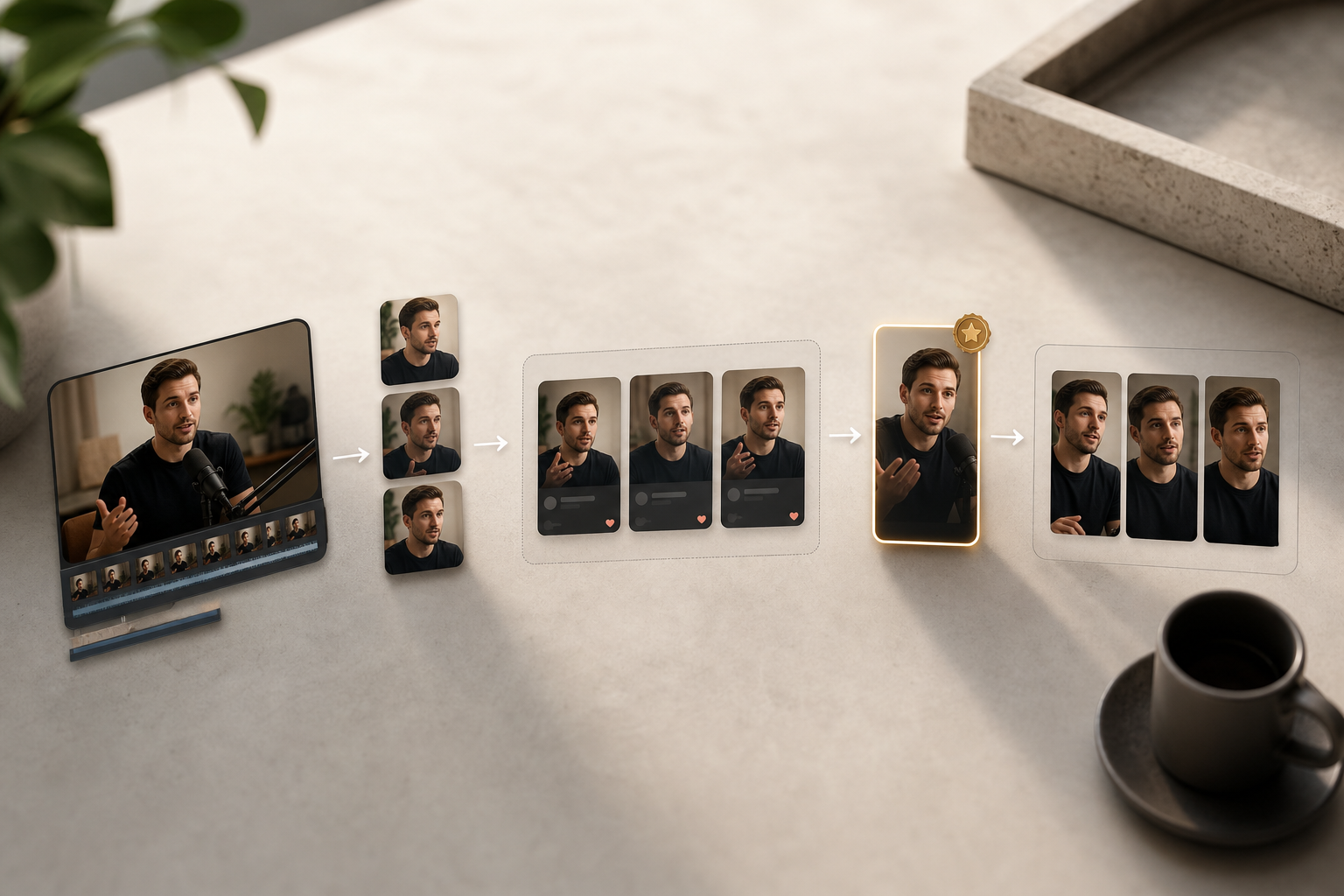
How a Hook Graduates to Scale
- Draft 6–12 hook variants mapped to a single lesson outcome.
- Post 3–5 lightweight test edits across low-risk accounts.
- Monitor 3-second hold, 50% watch, and saves for 24–48 hours.
- Promote the top 1–2 variants into polished edits for brand and niche accounts.
Content Validation and Scale
Content validation comes next. Instead of guessing which creative types will perform, we rotate through a tight, pre‑scoped set of formats, hook‑plus‑demo for fast wins, UGC avatar and voiceover for approachable how‑tos, slideshows for proof stacks, and greenscreen meme content for timely commentary, and measure how each format behaves against your audience. By watching saves, rewatches, and profile visits across these formats, we confirm not just what people watch, but what compels them to click. Only then do we “green‑light” a format for broader distribution.
Only after validation do we scale to the network. Multi-account distribution across 1,000+ human-run accounts lets us deploy proven content into several angles (brand account, student POV, niche micro-pages). Therefore, you reach broader top-of-funnel audiences without diluting your brand.
“Win small, then scale wide” is the operating mantra that keeps reach growing while protecting account health.
Posting Decisions Based on Signals, Not a Calendar
We make posting decisions from the ground up using actual engagement signals, watch time, rewatches, saves, comments, and click behavior, rather than forcing content to fit a calendar box. Because we refuse bots or fake likes, the data we study reflects genuine curiosity and intent. We deploy creative on TikTok and Instagram to extend the runway and diversify risk, ensuring that a single platform change can’t flatten your momentum. Example guardrails: promote if 3-second hold > 70% and saves > 0.3% of views in the test window, pause or rework if comments skew confused or CTR lags benchmarks.
In addition, we tune bios with clear value statements, target audience cues, credibility signals, and a strong CTA. For example, “Learn Python for data jobs • Built for busy analysts • Trusted by 3,000+ students • Free lesson link below.” Small bio tweaks lift click-through from profile to landing page, a key conversion step for course sales. We revisit these elements monthly alongside creative reviews because incremental improvements here compound your downstream conversion, especially during launch windows.
“Real-device deployment and human oversight give us clean data. Clean data means smarter scale decisions.”
Finally, we can mirror your strategy on Instagram Reels to reduce single-platform risk. Simultaneous management gives your strongest hooks two chances to win with zero extra work on your side. If you want a quick refresher on how creative angles map to campaign types, our TikTok Ads Manager primer breaks down naming and testing patterns you can repurpose.
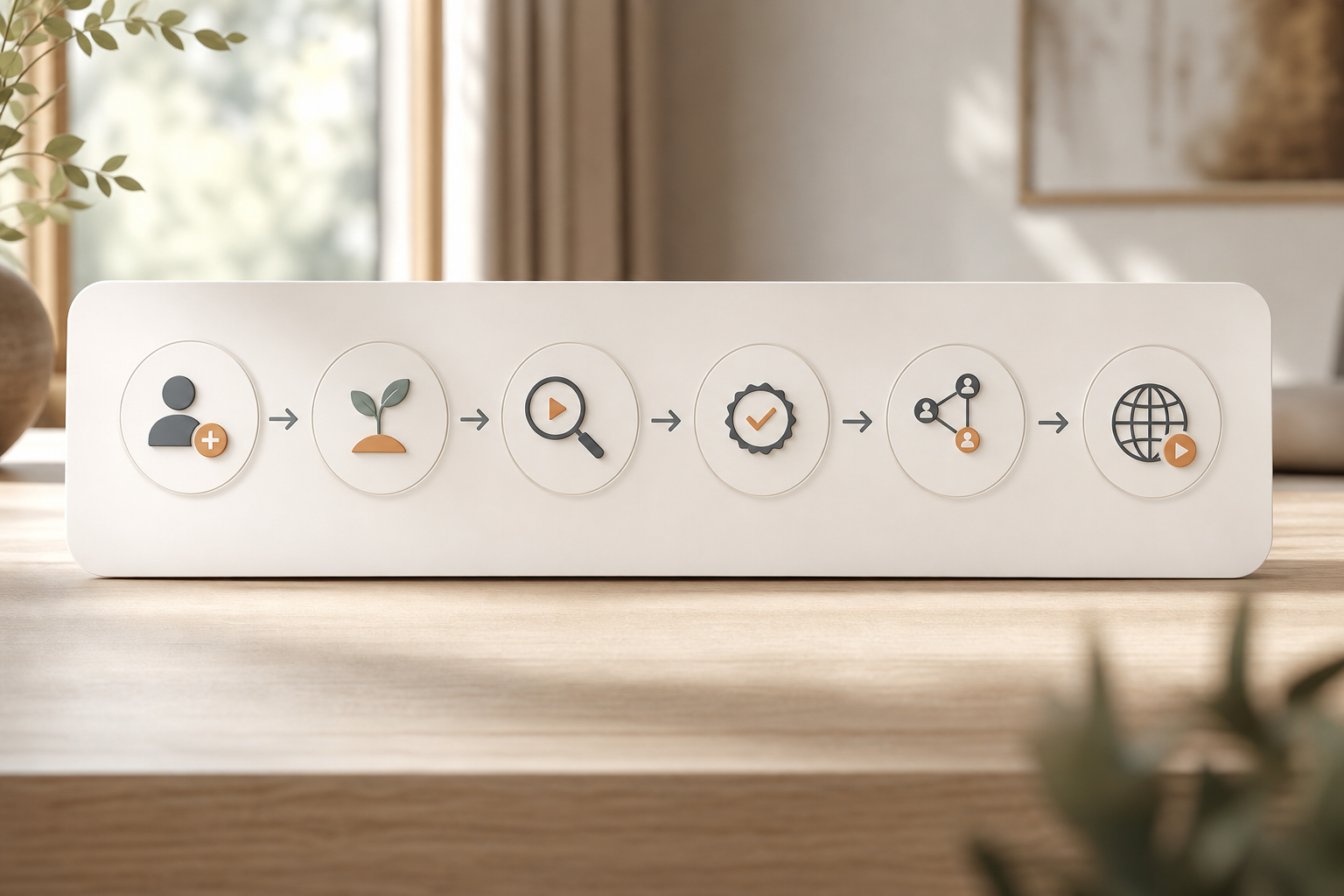
See packages and scale options → shows how creative labels and test groups keep data clean. Ask for a sample test matrix that includes hook IDs, edit variants, and graduation criteria so you can preview how decisions are made.
Production Workflow at a Glance
- Weekly cadence: We plan tests on Monday, launch Tue–Thu, and analyze Fri.
- Asset intake: You share a drive folder of clips; we tag by lesson, promise, and persona.
- Hook lab: 6–12 intro lines drafted per asset; top 3 proceed to edit.
- Compliance pass: FTC disclosures on testimonials and affiliate mentions where applicable.
- Caption system: Primary hook reiteration + curiosity gap + CTA + 3–5 relevant, non-spammy hashtags.
- Comment ops: We pin FAQs, hide spam, and escalate pre-sale questions to your team.
- Review windows: You can pre-approve sensitive themes; otherwise, we run within your guardrails.

Beyond the checklist, the real value is in consistency. We treat each week as a bounded experiment: commit to a finite set of hooks, launch them in a tight window, and hold the analysis cadence. This avoids the swirl of rolling tests with no clear read dates and keeps your team focused on decisions. Over a six‑to‑twelve week arc, this operating rhythm produces an audit trail you can learn from long after a campaign ends.
Editorial Guidelines We Follow (So You Don’t Have To)
- Voice and POV: Instructor-as-coach, jargon-light, benefits-first phrasing.
- Visuals: Large captions, punch-in edits, silent-friendly pacing, logo light.
- Compliance: No exaggerated claims; proof qualified with context and dates.
- Accessibility: High-contrast text, rhythm breaks, and on-screen labels for steps.
- CTA hygiene: One ask per post; mirror the hook language on the link destination.
Side-by-Side Comparison
| Dimension | Social Reel Farm | Generic Agency | Scheduler + VA |
|---|---|---|---|
| Account Safety | Real devices, human-run | Mixed; many use schedulers | API-based posting risk |
| Volume Capacity | Scale via 1,000+ accounts | Varies by team size | Limited to one main account |
| Hook Testing | Systematic, before scale | Rare or ad hoc | Rare and manual |
| Multi-Account Distribution | Yes, at scale | Limited | No |
| Course-Specific Playbooks | Yes, post types mapped to funnel | Varies | No |
| Cost-to-Output Ratio | High reach per dollar via network | Higher overhead | Lowest cost, lowest reach |
In addition, if you need full brand strategy, influencer deals, and long-form YouTube, a generalist agency might be the better fit. However, for course creators who need repeatable, safe, and scaled TikTok distribution without hiring a team, done-for-you tiktok posting through Social Reel Farm is the stronger match. You get structured warm-up, systematic hook testing, data-led iteration, and multi-account reach, all designed to protect credibility through zero artificial engagement.
 and account safety (real devices vs API); clean, neutral palette)
Also Read!
How to Test Video Hooks for Affiliate Marketing on TikTok and Reels
Why Course Creators Can Trust Social Reel Farm's System
Trust comes from process you can audit. Social Reel Farm runs 1,000+ manually managed mobile accounts across TikTok and Instagram, operated by real team members on real phones. Therefore, you avoid the gray areas of bot networks and questionable automation. In 2026, that level of operational control is the difference between steady reach and months stuck under a shadowban.
Zero artificial engagement is a standing policy, no bots, no fake likes, no purchased followers. As a result, your audience growth stays authentic, which matters for course sales where proof and trust drive clicks. Furthermore, posting is data-led. Decisions follow engagement signals, not a calendar, so you scale winners and cut what stalls.
Trust pillars at a glance: we rely on real‑device posting on human‑run phones, follow documented warm‑up and compliance guardrails, operate a clear test‑validate‑scale workflow with auditable trails, and extend multi‑account reach without gray‑hat tactics. Each of these pillars is simple by design and measurable in practice. You should be able to see which device posted what, when it posted, and which metric thresholds it cleared to earn more spend or scale. If a partner cannot surface that paper trail, you are running on hope rather than governance.
Transparency, human-run devices, and data-first iteration are table stakes if you care about brand-safe growth.
We also tailor account-specific growth strategies. A coding bootcamp, a watercolor academy, and a prenatal fitness course do not need the same hooks, formats, or posting windows. Therefore, we customize the warm-up cadence, content formats, and bio language to your niche.
Bio Structure That Converts Profile Views
Start with a value statement that says who you help and the outcome, then call out the exact learner segment so the right people feel seen. Add a line of credibility, such as student count, certification, or a notable placement, to anchor trust. Close with a clear CTA that spells out the next step, free lesson, quiz, or waitlist, so curiosity has somewhere to go. This simple four‑part structure keeps your profile from wasting the attention that your videos worked to earn.
Finally, we deploy cross-platform. Simultaneous TikTok and Instagram account management diversifies reach while keeping one content pipeline. That way, your strongest hooks compound across two discovery engines without doubling your workload. And yes, this trust-first approach applies across every step of our done-for-you tiktok posting system.

Access, Compliance, and Governance
Our access model uses role‑based permissions with per‑device 2FA so no one passes raw passwords in chat tools. For regulated niches, finance, health, education, we maintain disclaimer templates and clear approval lanes, and we log every post by hook, asset, and date so you can audit decisions later. Brand safety filters avoid restricted topics and risky hashtag clusters while a data retention and export policy ensures that, if you ever switch vendors, you leave with your learnings intact. The net effect is confidence: you get speed without sacrificing compliance or control.
Governance Artifacts You Receive
- Posting ledger: device ID, operator, timestamp, link, and hook ID per post.
- Creative matrix: hook lines, edit variants, captions, and results by cohort.
- Policy binder: warm-up plan, comment moderation SOPs, and compliance rules.
- Monthly audit: what scaled, what stalled, and which experiments run next.
How to Get Started with Done-For-You TikTok Posting
Getting started is simple, even if you choose another service. Preparation beats speed here.
Prep Checklist You Can Use With Any Vendor
- First, gather 3–5 course clips or assets we can repurpose. Short lesson excerpts, quick screen demos, or student wins work well.
- Aim for 15–45 seconds per clip; we can punch-in, add captions, and test multiple hooks.
- Include at least one proof-driven asset (testimonial, before/after, portfolio snippet).
- Second, define your ideal student avatar in one sentence. For example, “Working data analyst with 1–2 years in Excel, aiming for an entry-level Python role.
- Add 3 pains and 3 desired outcomes; these become hook angles.
- Note the vocabulary they use so the captions sound native.
- Third, clarify your conversion path. Do you want traffic to a free lesson, a lead magnet, or directly to a course sales page?
- Pick one primary CTA for 2–3 weeks to get clean data.
- Prepare a mobile-first landing page with a 5–7 word headline that mirrors the hook.
- Fourth, set a timeline you can trust. A structured account warm-up usually takes 2–4 weeks before campaign content scales. Rushing risks shadowbans and weak data.
- Add a simple content embargo window during warm-up so the signal stays clean.
- Block 30 minutes weekly for approvals and review.
- Fifth, know your metrics.
- Decide your “graduate to scale” thresholds (e. g., 3-second hold rate, saves per thousand views).
- Track a simple weekly scorecard so iteration beats guesswork.
Track the chain from views → profile visits → link clicks → opt-ins → sales. Watch the middle steps, not just top-line views. If you want to see how ad-side labels keep tests clean, our quick TikTok Ads Manager primer is a helpful skim.
Think of the journey in four checkpoints. First, views to profile visit rate tells you whether the hook generated enough curiosity to earn a tap, if this is low, rework intros and captions. Second, profile visit to click rate reflects the clarity of your bio and the pull of your CTA; small wording changes here can move mountains. Third, click to opt‑in rate measures message match on the landing page; headlines and lead offers should mirror the promise that earned the click. Finally, opt‑in to sale rate exposes whether your nurture assets close the loop; if this lags, improve onboarding emails or offer clarity rather than trying to brute‑force more top‑of‑funnel views.

Common Mistakes to Avoid in Week 1
- Mixing three CTAs at once; pick one destination for clean attribution.
- Posting from desktop emulators “just once” to save time; it isn’t worth the risk.
- Over-designing captions; clarity beats cleverness in educational niches.
- Ignoring comments; early replies boost signals and surface FAQs you can reuse as hooks.
- Rushing warm-up with daily heavy posts; steady, human behavior compounds trust.
Your Next Step
- Prepare those 3–5 clips and your avatar note.
- Decide the first CTA you want learners to take.
- Set a warm-up window you’ll respect.
Then, if our approach fits, check packages or book a quick call:
[See pricing and scale options →]

Also Read!
Best Video Hook Testing for Affiliate Marketers in 2026
Social Reel Farm vs TokUpgrade for Affiliate Marketers: Which Is Better for TikTok Account Warm-Up?
Frequently Asked Questions
How much does done-for-you TikTok posting cost for course creators?
Pricing varies by service and scope. Social Reel Farm publishes current packages on its pricing page, so you can compare options without guesswork. When you weigh cost, compare it to hiring a social media manager at $2,000–$5,000 per month or spending 10–15 hours per week doing it yourself. In addition, the multi-account distribution model spreads reach across many posts and pages, so your cost-per-impression is far lower than single-account management. For current rates, see the pricing page linked above.
Will I lose control of my brand voice with a done-for-you service?
No. Social Reel Farm uses a systematic hook testing process, so content is tested and validated before any scale. You provide source content and your messaging rules; we handle distribution and optimization, not brand positioning. Furthermore, growth comes from real user engagement with zero bots, which keeps the audience authentic and aligned with your tone. As a result, you keep strategic control while we run the posting system.
How long before I see results from DFY TikTok posting?
Be honest with yourself about time-to-scale. A structured account warm-up takes 2–4 weeks before campaign content goes live. Rushing past warm-up risks shadowbans and poor data quality that can stall growth for months. After warm-up, results build as the network identifies hooks and formats that earn watch time and clicks. Over time, data-led posting decisions compound reach and improve click-through to your landing pages.
Can't I just use a scheduling tool and a virtual assistant instead?
You can, and it’s a valid budget path. However, most scheduling tools rely on API-based posting that TikTok can detect, which can hurt account health. A VA running one account also can’t match the distribution or testing speed of 1,000+ manually managed mobile accounts. In addition, there’s usually no systematic hook testing or content validation before scale. For course creators who need volume-based reach, DFY services bring infrastructure that a VA stack can’t match.
Does Social Reel Farm only work for TikTok or also Instagram?
We deploy cross-platform for consistent visibility on both TikTok and Instagram. This matters because students browse on more than one platform before they buy a course. Simultaneous management means one content plan fuels two discovery engines without doubling your workload. Therefore, your best hooks get two chances to win with the same prep.
Is multi-account posting against TikTok's terms of service?
The concern is fair. Social Reel Farm uses real-device deployment with real team members managing accounts on actual mobile phones. This human-run approach is different from bot networks or gray-hat automation. In addition, our structured warm-up process and real user engagement policies are designed to work within normal platform behavior, not to trick it. By contrast, automation tools that post via unauthorized means can violate TOS and risk penalties.
What types of course content work best on TikTok?
Hook + Demo videos that show a fast outcome perform well for early awareness. Slideshow videos are strong for testimonial-style proof that nudges a click. Greenscreen meme content helps you ride timely topics while adding your expert commentary. UGC-style content builds trust and scales on light production days. Social Reel Farm supports all these formats and tests them before expansion, so only proven winners get scaled.
What if my course is in a boring or technical niche?
No niche is boring if the hook earns the next three seconds. Systematic hook testing exists to find what resonates, even for technical topics. We test multiple hooks and formats before any scale, then expand what gets watch time and saves. Because posting choices are data-led, decisions come from real engagement signals, not guesses about what “should” work. That way, your expertise meets the platform’s attention rules.

Do I need to record new videos every day to make this work?
Not at all. Many course creators can repurpose lesson excerpts, webinar clips, student wins, and screen demos. With a strong hook library and light editing, a single 30–60 minute recording session can fuel weeks of testing. Our system emphasizes hook variety and angle mapping over constant reshoots, which preserves your teaching time. When you do record net-new content, we’ll plug it into the same testing structure so you’re never guessing which version deserves scale.
How do you protect my brand while posting from multiple accounts?
Brand accounts use your name, guidelines, and CTA. Supporting accounts (student POV, topic micro-pages) are positioned as community pages with transparent bios and clear value statements. All content routes to your owned assets. Creative is reviewed against your messaging rules, and we maintain an approval workflow for sensitive topics so distribution scale never outruns brand safety. When in doubt, we default to the brand account and pause secondary pages until clarity is restored.
What reporting will I see and how often?
You’ll get weekly summaries that list tests launched, hook variants, early signals (3-second hold, 50% watch, rewatches, saves), and “graduates” that move to scale. Monthly rollups include reach, profile visits, clicks, and opt-ins/sales where available. We also include notes on what to cut, what to double down on, and 2–3 concrete experiments for the next sprint. If you need executive snapshots, we can provide a one‑pager that rolls metrics up to cost per qualified click and pipeline impact.
Can you support live launches or cohort enrollment windows?
Yes. We align warm-up timing and hook selection to pre-launch, open cart, and last-call phases. For example, we’ll prioritize authority and proof hooks during warm-up, switch to urgency and offer clarity during open cart, then recycle the top-performing proof snippets during the final 24–48 hours. Multi-account reach helps your deadlines show up more often without spamming one page. We’ll also match posting windows to your email drops so momentum stacks rather than competes.
Do I need to be on camera, or can you use voiceover and B-roll?
Both options work. We can scale face-forward clips when you want to appear and switch to UGC-style voiceover, screen demos, and B-roll on off-camera days. Hook testing finds the intros that carry either format so you never stall because you can’t film. If camera confidence is the blocker, we’ll script voiceover‑first demos that still feel personal and authoritative.
How do you handle comments and community management?
We monitor comments during the first 24–48 hours for each post, pin helpful FAQs, and hide spam. Pre-sale or technical questions are summarized and sent to your team with suggested replies. If you prefer, we can use approved reply templates to keep response times fast and on-brand. For spikes, we spin up temporary reply blocks to cover the busiest hours after a high‑performing post lands in feed.
What access and security controls are in place?
We use per-device 2FA, role-based access, and a documented login handoff. No raw passwords are shared in chat tools. You retain ownership of pages and can revoke access at any time. All posting activity is logged so you can audit who did what, when. If you need SSO or IP allowlisting for larger teams, we’ll coordinate that during onboarding.
How do you attribute sales to TikTok?
We combine platform metrics (profile visits, clicks) with UTMs and landing page analytics. For cohort launches, we also track time-bound spikes that align with posting windows. While last-click often credits email, TikTok fills the top-of-funnel; our reporting highlights assist metrics so you can see the full picture. On evergreen funnels, we watch moving averages to filter noise and surface the creative that keeps feeding your pipeline reliably.
Can you collaborate with our in-house team or other agencies?
Yes. We can operate as the distribution engine while your team handles ideation and filming, or vice versa. Shared calendars, test matrices, and weekly standups keep roles clear. If you already retain a brand agency, we’ll inherit voice/tone guidelines and focus on testing and scale.
What happens if a post attracts negative comments?
First, we triage tone and validity. Constructive critique is acknowledged and, when helpful, becomes a content idea. TOS-violating or abusive comments are hidden. We maintain a crisis playbook with pre-approved responses for sensitive topics and escalate to your team when brand or legal judgment is required.
Can you localize content for different regions or languages?
We can support basic localization with caption translations, localized CTAs, and region-appropriate examples, then test performance by market. For full multi-language production, we’ll coordinate with your team’s translators and adapt hooks to local idioms while preserving the core promise.
Key Takeaways for Course Creators
First, TikTok is a distribution system, not a side task. A steady cadence, structured warm-up, and validated hooks matter more than any single post. Second, real-device posting, zero artificial engagement, and data-led iteration protect your account and your brand in 2026 and beyond. Third, multi-account distribution and format diversity give your ideas more shots on goal without adding hours to your week.
- Quick next steps:
- Choose one CTA and one avatar to start.
- Prepare 3–5 clips and 6–12 hook lines per clip.
- Commit to a 2–4 week warm-up and a 6–12 week testing window.
If you’re ready to see how this maps to your course, we’ll keep the next step simple.
[Start with a warm-up plan today →]