
 Post by
Short-form sells courses, but only when distribution matches production. If you need AI UGC video creation in 2026, the best path is to pair believable AI UGC with human-run, warmed accounts that test hooks fast and scale winners.
You’re not chasing pretty videos. You’re chasing reach that turns to enrollments without burning your face on camera every day. Tools can make assets, but distribution and account health decide who gets seen. Systems that combine human-operated posting on real devices, structured account warm-up, and data-led hook testing win by design.
Social Reel Farm operates 1,000+ manually managed mobile accounts across TikTok and Instagram with zero artificial engagement, and it runs a warm-up → test → validate → scale method before any big push. That is the difference between a flood of views and a dead post from a cold profile. In 2026, results hinge on trust signals the platforms can measure, not on hype.
 → human-operated posting on many real mobile devices → data dashboards → scale decision; clean flat design, bright accents)
Why Course Creators Struggle With UGC Video at Scale
The job is not just “make more videos.” You need believable faces and social proof that feel earned, not staged. In education, you sell judgment and trust, so fake-looking AI skins or stiff lip-syncs hurt more than they help. Meanwhile, real UGC creators cost $150–$500 per video and vary in tone, turnaround, and brand fit. You can’t A/B 15 hooks this week if three freelancers miss deadlines.
Even when the content is good, distribution kills it. One cold account posting two AI clips per day looks like spam to a platform tuned to spot bot behavior. Burst posting from new profiles, device farms, or automation tools raises flags and chokes reach.
If you’ve seen a clip get initial views then stall for days, you’ve hit the distribution bottleneck. The content wasn’t the only problem. The pipe was.
For course creators, the authenticity gap is brutal. Prospects want to see peers who got results, quick demos of your method, and a charismatic explainer that doesn’t reek of stock footage. AI can help here, but only if the avatar quality passes a glance test and the format matches the message. A 12-second hook plus demo can pull attention, while a full talking head might expose uncanny flaws and sink trust.
Moreover, your funnel needs many hooks, not one. “Learn the skill” vs. “Beat your plateau in 2 weeks” vs. “Avoid this newbie error” each hits a different segment.
If you post all three from one new profile in 48 hours, you’ll trigger cold-start drag. If you pace them across many warmed, real-device accounts, you’ll find a winner faster. That’s why scale is not optional; it’s the only way to find fit before fatigue.
Cold accounts and bot-like patterns are a reach killer. The issue is behavior, not whether a video used AI at any point. See shadow banning for how platforms throttle suspicious activity.
The real constraints you’re fighting
- Time: you can’t be on camera 24/7, and freelancers won’t match your cadence.
- Consistency: trust breaks when “testimonials” look fake or shift tone daily.
- Distribution: one account is a dead end; warmed, real-device networks move the needle.
By naming these constraints early, you can design a system that tests many hooks without risking bans, keeps bios conversion-ready, and routes traffic to your course pages.
What to Look for in an AI UGC Video Service (Buying Criteria for Course Creators)
Not all services are built for trust-sensitive niches like education. You’re selling knowledge, not a gadget, so the bar for “real” is higher. These criteria map to course funnels where a 10-second claim must hold up under scrutiny and send qualified traffic to a page that converts.
1) Avatar quality and realism
For testimonials or explainer clips, faces must look and move like a real human at phone-screen size. However, you don’t need pixel-perfect faces in every format. Hook+demo and slideshow formats lean on b-roll, captions, and proof shots, which carry the message without overexposing AI lips and teeth. In education niches, that balance keeps trust intact while you test fast.
2) Hook testing capability
Hooks win or lose the first three seconds. You need a service that can run 10–20 hook variations per week and read view retention plus watch time to pick a winner. Systematic hook testing means small batches, daily reviews, and pruning weak lines. Without this, you scale the wrong idea and burn spend. Think of it as creative search, not creative “set and forget.
3) Multi-format support
Your offer has layers: testimonials for proof, quick demos for curiosity, slideshows for curriculum highlights, and greenscreen memes for topical reach. The service should cover hook+demo, slideshow, greenscreen, and talking-head formats so you can match message to format. Format agility lets you keep testing without “samey” fatigue that caps reach.
4) Distribution infrastructure
Ask bluntly: do they only make videos, or do they also post them? Course creators don’t just need assets. You need multi-account content distribution and cross-platform deployment on TikTok and Instagram, run by humans on real devices. Creation without distribution is a bottleneck dressed up as a deliverable.
5) Account health
Account bans and throttles waste weeks. A credible provider warms accounts before any campaign content goes live and maintains gradual posting consistency. They should tailor account-specific growth strategies so each profile earns trust on its own path instead of blasting the same schedule everywhere. This matters more than nice avatars.
6) Data-driven iteration
It’s not enough to “feel” that a hook is strong. You want data-led posting decisions based on engagement signals. That means daily or near-daily reads of retention curves, comments that signal buying intent, and CTR from profile to course page. Then, content validation before scaling to full network avoids throwing fuel on weak creatives.
7) Platform compliance
Real-device deployment instead of bots is non-negotiable. Zero artificial engagement keeps your accounts clean, which is how you avoid throttles and keep links live. A provider should operate 100% with real team members and avoid any automated engagement tricks that put your assets at risk.
| Criterion | Why it matters for courses |
|---|---|
| Avatar realism | Trust-heavy niches punish fake faces; pass the glance test |
| Hook testing | 10–20 hooks per week finds fit before fatigue |
| Multi-format | Match message to format (proof, demo, curriculum, meme) |
| Distribution | Assets die without warmed, human-run accounts |
| Account health | Warm-up and pacing prevent bans and throttles |
| Data-led | Scale only what engagement validates |
| Compliance | Real devices, zero artificial engagement, long-term safety |
Also Read!
How to Test Video Hooks for Your Ecommerce Brand (Step-by-Step)
Social Reel Farm vs TokUpgrade for Course Creators: Which Is Better for TikTok Account Warm-Up?
How Social Reel Farm Solves AI UGC Video Distribution for Course Creators
Social Reel Farm combines production and distribution in one system designed for course funnels. On the content side, you get Hook + Demo videos for quick course previews, UGC avatar generation for authentic-looking testimonials, slideshow videos for curriculum highlights, and greenscreen meme content for top-of-funnel reach. On the distribution side, you get cross-platform deployment on TikTok and Instagram through 1,000+ manually managed mobile accounts operated by real team members.
Before a single promo clip goes live, accounts go through a structured account warm-up. That includes gradual posting consistency and organic behavior long enough to earn trust, not just avoid flags. Then, the team runs systematic hook testing for improved view retention. Early posts validate messaging and format. Only after content validation do winners scale to the full network.
Zero artificial engagement is a hard rule. There are no bots, no fake likes, and no “boost groups.” Instead, real-device deployment and human operations keep behavior natural. That keeps your offer visible and protects long-term account health. It also means your data is clean. When a hook wins, it wins on merit, not on a synthetic push.
Bios matter more than people think. Social Reel Farm’s structured bio elements include clear value statements (“Who this course is for”), target audience indicators (“Designers who want a UX job”), credibility signals (notable outcomes or press mentions you provide), and strong calls-to-action. That structure turns profile visitors from viral clips into course buyers, not just passive scrollers.
Moreover, data-led posting decisions use actual engagement signals, not gut calls. If your “3 mistakes” hook outperforms “before/after” in saves and comments by students, the posting schedule shifts that way. If greenscreen memes bring reach but weak profile clicks, the system throttles them and doubles down on hook+demo for warmer traffic. That’s how you iterate fast without wasting lift on the wrong creative.

**Get instant pricing details →
Social Reel Farm vs. DIY AI UGC Tools: An Honest Comparison
Standalone AI UGC generators like Synthesia, HeyGen, or Arcads are good at one thing: making videos. They’re cheaper per asset and fast for one-offs. But they stop at export. You still have to run account warm-up, manage posting cadence, test hooks, and avoid cold-start penalties. That’s where most course creators fail, not for lack of content, but for lack of distribution and account health.
Hiring freelance UGC creators on Fiverr or Upwork gives you a real human face, which can help with trust. Yet, consistency and scale break first. Turnaround is slow, tone drifts with each creator, and at $150–$500 per clip, testing 10–20 hooks per week becomes financially and operationally painful. You end up with a handful of assets and no clear signal on what to scale.
Social Reel Farm’s full-stack approach solves the operational math. Creation happens in multiple formats (Hook + Demo, UGC avatar testimonials, slideshows, greenscreen) and gets posted through multi-account content distribution. Before any scale, format testing and hook testing run on warmed profiles. Then, winners expand across 1,000+ manually managed mobile accounts with simultaneous TikTok and Instagram account management. You don’t guess which idea to back, you see it in the data, then scale it.
For a creator who needs to test 10–20 hooks each week, multi-account deployment is the difference. With one or two cold profiles, you’re stuck at one test per day and noisy reads. With structured account warm-up and content validation before scaling, you can place those 10–20 hooks across many healthy accounts, reach diverse micro-audiences, and find your top quartile fast. Compared to alternatives, this is not about “more videos.” It’s about more chances to win, without risking bans.

Trust Signals: Why Course Creators Can Rely on This System
Trust is earned through operations you can see, not slogans. Social Reel Farm runs over 1,000 manually managed mobile accounts operated by real team members. Every post ships from a real device, not an emulator, and there is zero artificial engagement. That operational choice protects account health and keeps your data honest.
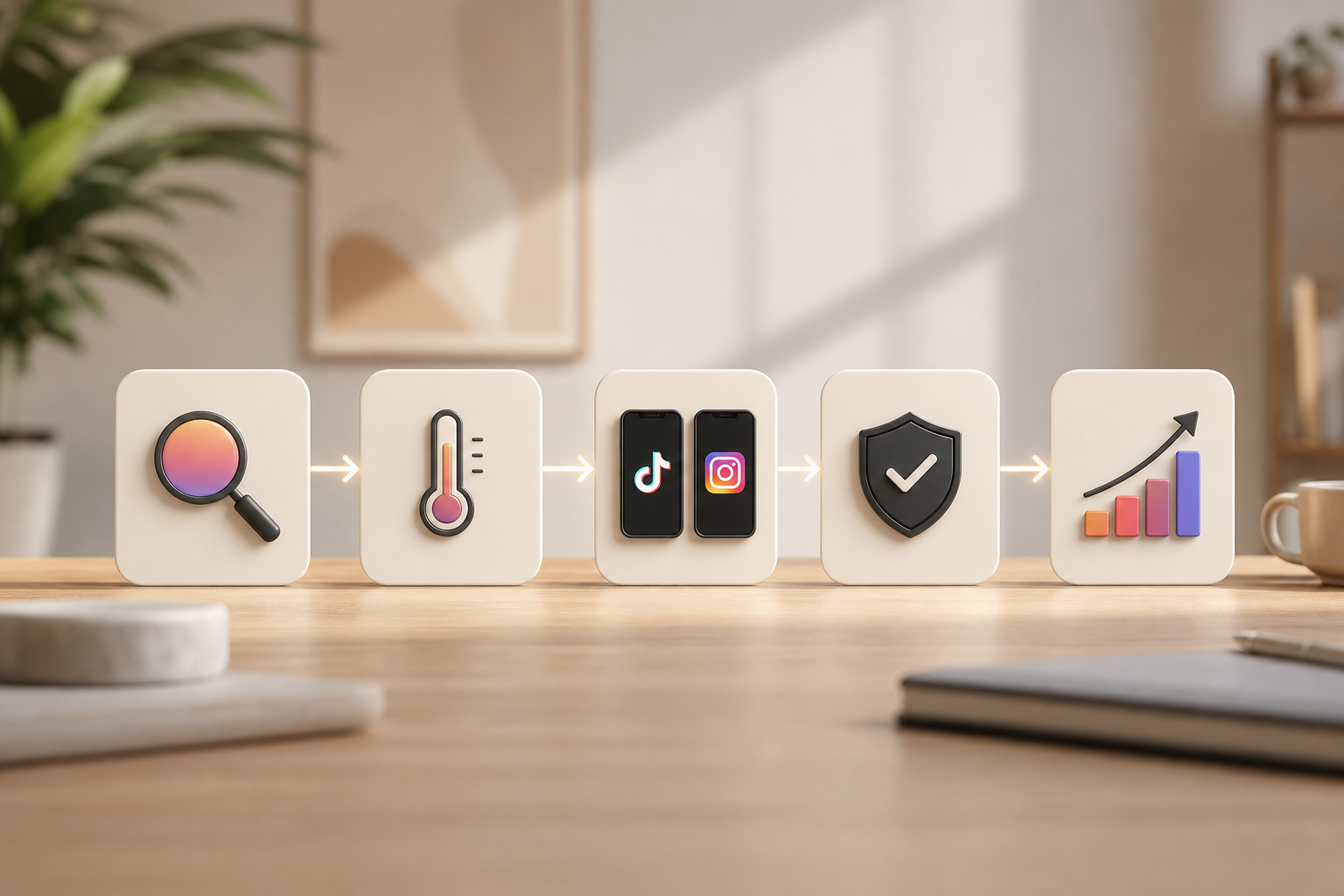
The method is structured: warm-up → test → validate → scale. Structured account warm-up and gradual posting consistency reduce bans and soft throttles that derail new profiles. Then, content validation before scaling to full network ensures only proven hooks get broad placement. That’s how you build durable reach that doesn’t vanish after one lucky post.
Cross-platform deployment on TikTok and Instagram spreads risk and increases surface area for discovery. Tailored, account-specific growth strategies keep each profile healthy, instead of forcing one posting pattern across the board. When a niche needs more “how-to” slides versus greenscreen memes, the plan adapts at the profile level.
“Zero artificial engagement” means no purchased likes, no pods, no bots—only human-run activity on real devices that aligns with platform rules.
For course creators, this matters because your brand depends on platform trust. A ban wipes months of build-up and tanks launch timelines. A throttled profile hides great hooks from the right students. By choosing a system with real-device deployment instead of bots and data-led posting decisions, you protect your funnel and keep your audience path open.
Also Read!
Getting Started: How Course Creators Onboard With Social Reel Farm
Onboarding is designed to get you from interest to first valid tests without guesswork. It starts with a free consult. You bring your course angle, target student, and any existing assets. The team brings a plan for formats, hooks, and where to place them across warmed accounts. You keep building your curriculum while the system handles done-for-you account warmup and structured posting.
Step 1: Discovery. An initial consultation clarifies your course niche, target student, and key proof points. You’ll align on which formats fit best (hook+demo for curiosity, slideshow for curriculum, greenscreen for reach).
Step 2: Setup and warm-up. Accounts enter a structured account warm-up phase before any campaign content. Expect gradual posting, human browsing, and normal behavior signals to earn trust.
Step 3: First hook tests. Systematic hook testing for improved view retention begins with small batches across selected accounts. You’ll see early engagement reads and which angles pull.
Step 4: Validation. Content validation before scaling to full network confirms the winners to back with more placements.
Step 5: Scale and refine. Data-led posting decisions expand winners, while new hooks enter the test lane to keep the pipeline fresh.
Timelines are real, not rushed. The warm-up phase takes time, and the first few weeks focus on learning. You’re not waiting forever, but you’re also not blasting from cold accounts. This balance protects reach and sets you up to scale once the data points to clear winners.
 , warm-up protocol, data-led testing, zero artificial engagement, cross-platform)
Frequently Asked Questions
How much does AI UGC video creation and distribution cost for course creators?
Pricing varies by campaign scope and by how many accounts you deploy. For context, individual freelance UGC creators charge $150–$500 per video, and that cost rises fast when you need to test 10–20 hooks per week. Social Reel Farm’s bundled creation + distribution model usually gives better unit economics at scale because distribution is built in. For current rates and options, see the pricing page. You can scope a package that matches your testing volume and niche.
Do AI-generated UGC avatars look realistic enough to sell online courses?
Avatar quality has improved a lot in 2026, but format choice matters more than raw face fidelity. Hook+demo and slideshow formats rely on captions, overlays, and proof shots, which keep trust high even if you avoid full talking heads. Social Reel Farm supports multiple formats so you can test what feels right for your audience. If your niche leans skeptical, you can emphasize real b-roll and text-first formats while you validate hooks.
Won't TikTok or Instagram ban accounts that post AI UGC content?
The risk comes from bot behavior and cold account blasting, not from using AI in production. Social Reel Farm mitigates this with structured account warm-up before campaign content, real-device deployment instead of bots, and gradual posting consistency across 1,000+ manually managed mobile accounts. Zero artificial engagement keeps behavior natural and trust intact. With this approach, AI-assisted content posts like any other short-form asset.
Can I use standalone AI video tools like Synthesia or HeyGen instead?
Yes. Those tools are fine for making single videos or quick drafts. The bottleneck is distribution, one cold account posting AI UGC won’t deliver meaningful reach. Social Reel Farm combines creation with multi-account distribution and systematic hook testing so you find winners faster. You can still use your favorite tool for asset generation while the team handles posting and scale.
How long does it take to see results from AI UGC campaigns for course sales?
Expect a warm-up phase before campaign content goes live, then an initial period focused on hook testing and iteration. Most structured campaigns begin generating meaningful engagement signals within the first month, with scaling after content validation. The exact pace depends on your niche and how many hooks you test. The method protects account health while you build momentum.
Does Social Reel Farm work for all types of online courses?
The system adapts to niches by testing format + hook pairs that match each audience. Whether you sell a fitness program, business coaching, or a technical skills course, data-led posting decisions steer toward what your viewers save, share, and click. Cross-platform deployment on TikTok and Instagram broadens discovery while account-specific growth strategies keep profiles healthy. The process fits the niche; the signals tell you what to scale.
What's the difference between AI UGC and hiring real UGC creators for my course?
Real UGC creators bring human faces but are slow to scale and expensive at $150–$500 per video. You can’t reasonably test 10–20 hooks every week that way. AI UGC enables rapid iteration across formats, so you can find working angles faster. Social Reel Farm’s approach adds multi-account deployment, account warm-up, and data-led iteration, pieces that single freelancers can’t provide at scale.
Can I provide my own course content for the AI UGC videos?
Yes. During onboarding, you’ll share your materials, proof points, and target student profiles. The team builds hook+demo videos, slideshows, and other formats around that source content, optimized for short-form algorithms. You keep control of the message while the system handles production pacing and distribution. That’s how your voice stays consistent as you scale.
Key Takeaways
- Distribution decides winners. Pair believable formats with human-run posting on real devices and warmed accounts.
- Testing beats guessing. Systematic hook and format tests, then content validation before scaling, cut time-to-signal.
- Account health compounds. Zero artificial engagement and structured warm-up protect reach you can grow.