
 Post by
Short-form video hook testing is the fastest, most controllable way for agencies to lift reach and watch time in 2026. In the first two seconds, a decisive hook determines whether the algorithm amplifies your client’s story or buries it.
**[Get instant pricing today →]
Why the First 1-3 Seconds Decide Everything for Your Clients
On TikTok, viewers decide to scroll in about 0.3–1 second. On Instagram Reels, early drop-off sends a negative signal that limits distribution even if the rest of the video is solid. For agency teams, that means the opening beat is not “nice to have.” It’s the control point. If you win the first three seconds, you earn the right to sell the story, demo the proof, and drive the CTA.
Agencies face a unique load. You’re not testing hooks for one creator who knows their lane. You’re testing across verticals: skincare, B2B SaaS, local service, personal brand, each with different social norms. Gut feel doesn’t scale across that spread. Instead, you need a method that isolates the variable that matters most: the first 1–3 seconds.
Define hook testing this way: it’s the practice of isolating and varying only the opening 1–3 seconds of a short-form video while holding the body and CTA constant. Then you measure retention rate and swipe-away rate to pick a winner with real signal. Short-form video hook testing is surgical. It is not a full video A/B.
Whole-video tests blend too many variables and blur the result; if you want background on test design, skim A/B testing.
For example, say you run a skincare client.
- Question hook: “Did you know your moisturizer is doing this?
- Result hook: tight macro of glowing skin, no text, clean lighting.
- Pattern interrupt: a sharp sound cue plus a surprising visual cut (e. g., cream on a lemon).
- Authority hook: “I’m a dermatologist—stop doing this before sunscreen” while flashing a credential.
What to Measure in the Opening Seconds
- 1-second view rate: percent of impressions that reach 1 second.
- 3-second retention rate: percent that make it to 3 seconds.
- Swipe-away rate: percent who swipe before 1 second.
- Optional: average watch time to sanity-check that the best hook doesn’t tank mid-video performance.
These numbers tell you, quickly, if the hook earns the next breath. They also align well with data-led posting decisions your clients expect. Benchmarks vary by niche and account maturity, but as a starting point, aim for a 1-second view rate above 60–70% and a 3-second retention rate that is at least 20% higher than your recent median for that account.
Benchmarks and common pitfalls
- Expect volatility under 1,000 impressions. Don’t crown a winner too early.
- Beware “empty curiosity” hooks that spike 1s/3s but collapse average watch time; they can hurt future distribution.
- Keep UI safe zones in mind. If captions or on-screen buttons cover the hook text, your rates will understate the concept’s potential.
- Validate sound-on vs. sound-off. If 70% of your audience watches without sound, visual-first hooks should be the priority.
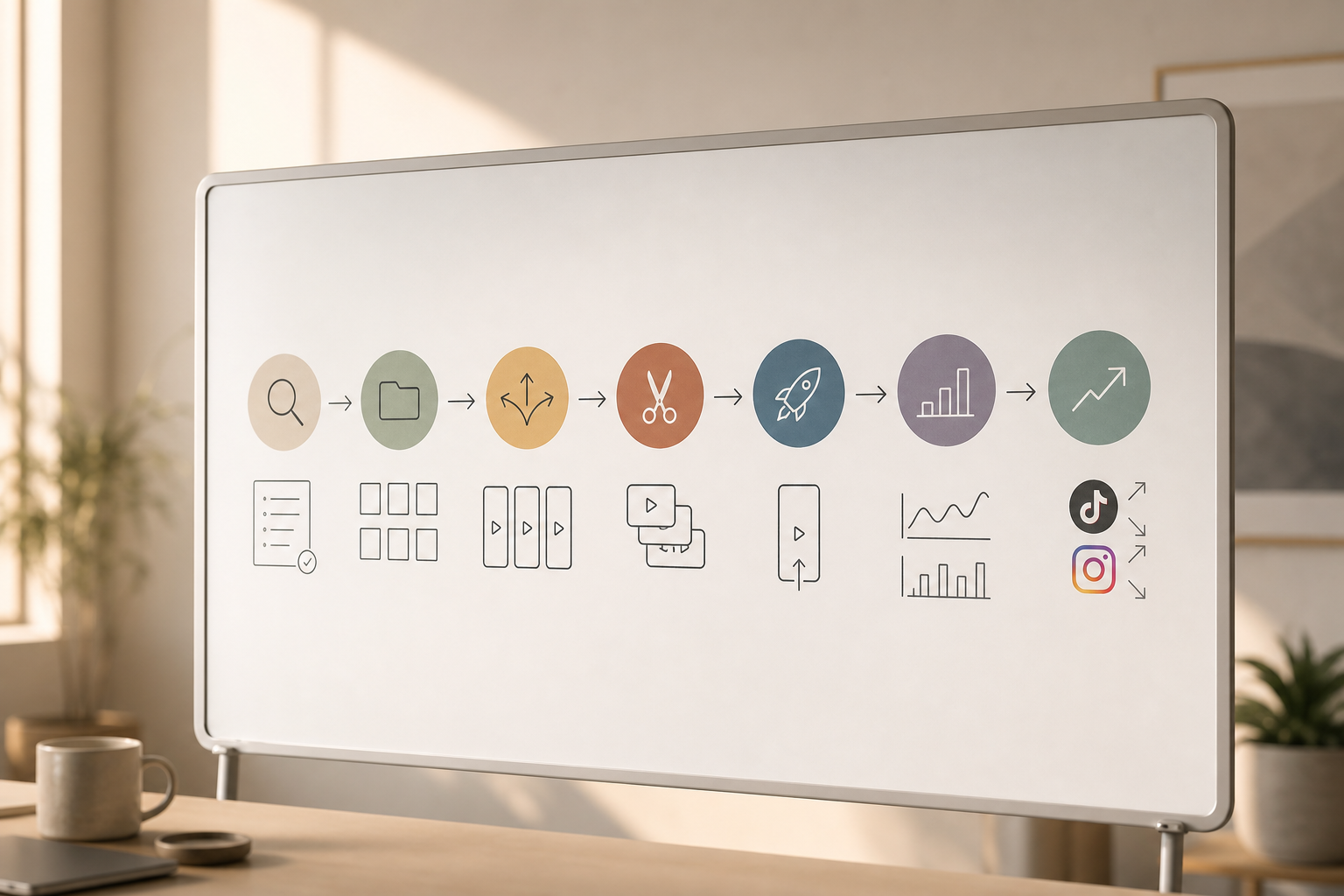
A Step-by-Step Hook Testing Framework for Agency Teams
This is the framework we run in weekly sprint cycles. Use it as-is on Monday. Adapt later.
-
Audit existing content
Pull the top 10 and bottom 10 videos per client from the last 60 days. Tag the hook type used: question, bold claim, visual pattern interrupt, testimonial clip, text overlay cold-open, or before/after reveal. Then note the common threads in winners and losers. If possible, export retention curves so you can see the exact moment drop-off stabilizes. -
Build a hook library
Create a shared doc or Notion database with archetypes by vertical. Include clear examples and tags so the team can search quickly.
-
Bold claim: a specific, testable promise (“Cut editing time by 42%”). – Pattern interrupt: an odd sound or visual that pauses the thumb.
-
Before/after: fast reveal of outcome, then rewind to how. – Social proof: a one-line testimonial or “X users” cold-open. – Counterintuitive tip: a “don’t do this, do that” opener. – Urgency: “You have 7 days to fix this setting” or a countdown timer.
-
Authority: expert POV or credential in the first frame (badge, lab coat, dashboard). – Question: a direct “you” question that frames the viewer’s problem. – Visual ASMR: satisfying textures or sounds that instantly create curiosity.
-
Script 3–5 hook variants per video
Write hooks that span emotional, rational, and curiosity angles. Keep the body and CTA identical. The goal is short-form video hook testing, not full creative rewrite. Add a short rationale under each hook (e. g., “curiosity + pattern interrupt”) to help future reviews. -
Produce minimal-effort variants
Do not re-shoot the whole piece. Re-cut the first 1–3 seconds, swap initial text overlays, or change the opening audio sting. This keeps cost and time low while you stress the first beat. Where possible, create modular intros so editors can drag-and-drop hook tiles over the same body footage.
Pro tip: Build a 1–3 second “intro reel” for each brand—10 silent first frames and 10 sound-first stings—so editors can test without opening a timeline from scratch.
-
Deploy and measure
Post variants on the same account, staggered by 24–48 hours, or on parallel accounts at the same time if you have that setup. Track three core metrics: 1-second view rate, 3-second retention rate, and average watch time. Aim for at least 1,000 impressions per variant before you read the result, and normalize for posting time by rotating dayparts across variants in future sprints. -
Scale the winner
When one hook clears a 20%+ lift in 3-second retention at 1,000+ views (ideally 3,000+), scale it across the remaining accounts. Then use the winning hook type to inform the next batch of scripts. Spin off 2–3 micro-variants of the winner (e. g., same text, different first frame) to harden the learning and reduce reliance on a single creative expression. -
Document and feed back
Log winners with screenshots and notes in the hook library. Tag by vertical and audience segment. This builds institutional knowledge, not just one-off wins.
Repeat weekly. Format testing before expansion keeps your pipeline efficient. Include a short “why it worked” note so future editors can replicate the pattern with intent.
Tools and Data Stack for Hook Testing
Category 1: Native analytics (TikTok, Reels, Shorts)
Start with the analytics inside each platform so you can read signal where it’s generated.
- TikTok: Monitor “Video views at 1s/3s,” retention graphs, swipe-away rate, and traffic sources. Use the audience tab to confirm whether a hook is pulling in the intended demo or just broad reach.
- Instagram Reels: Check retention at 3s, 10s, and 50% watch, plus “Accounts reached” and “Plays vs. Reached” to spot early hook friction. High “Forward” taps in the first second often signal a weak opener or mismatched visual.
- YouTube Shorts: Focus on “Average view duration,” “Percent viewed,” and “Impressions vs. views” alongside the first-second retention from the audience retention chart. Shorts often reward a clearer narrative promise in frame one.
- Tip: Always pair quantitative reads with a quick frame-by-frame review of the first 3 seconds to confirm what the viewer actually saw and heard.
Category 2: Third-party dashboards
If you manage many clients, tools like Metricool, Sprout Social, or Dash Hudson help compare variants side by side. You can tag each post by hook type and pull cross-platform comparisons. This saves time when you present to clients on Monday. Many dashboards also export retention screenshots, which makes your weekly wrap-ups more visual and persuasive.
Category 3: Creative production tools
CapCut, Descript, and Canva Video let you re-cut the opening beat fast. Swap the first shot, change the first caption, or add a signature audio sting. Because you’re only touching 1–3 seconds, you can output five variants in under an hour. Consider building a shared asset folder with reusable openers, subtitle templates, and SFX hits so editors move faster.
Category 4: Multi-account management and distribution
For agencies running tests across many accounts, services like Social Reel Farm handle multi-account deployment on real devices, systematic hook testing, and account warm-up. The system manages 1,000+ manually managed mobile accounts operated by real team members, focuses on format testing before expansion, and avoids bots entirely with real-device deployment. That removes the bottleneck of pushing dozens of variants while keeping data-led posting decisions intact. You maintain creative control while offloading the operational grind of distribution and posting cadence.
Category 5: Documentation and knowledge management
Keep your hook library and results in Notion, Airtable, or a well-structured Google Sheet. Log the hook text, type, platform, 1s/3s metrics, average watch time, and date. Over a quarter, this becomes your map of what wins by vertical. Build simple views: by client, by hook type, by platform, and by performance tier so PMs can pull examples in seconds.
- No single tool solves everything; the right stack depends on client volume and budget.
- Start with native analytics and a shared doc, then add dashboards if reporting load grows.
- Keep creative tools simple so your team can ship more tests, not bigger edits.
What to Do This Week: Your First Hook Test Sprint
Day 1 (Audit): Pick one client account. Pull the last 20 videos. Tag hook types and rank by 3-second retention.
Flag the top 3 and bottom 3. Screenshot the opening frames for side-by-side review. If your account size is small, go back 90 days to gather enough examples.
Day 2 (Write): Draft three hook variants for the next planned video: one question, one visual pattern interrupt, and one before/after. Keep the middle and CTA identical across all three. Draft a plain-text post description and first-comment variation if the platform supports it, but don’t change the main video body.
Pro tips for the sprint
- Lock your hypothesis per variant in the filename or a shared note (e. g., “visual novelty vs. direct question”) so the team knows what you tried.
- Keep first-frame brightness high. Underexposed openings undercut even great concepts.
- Avoid long on-screen names or disclaimers in the first second; add them at 2–3 seconds.
- When in doubt, prioritize clarity over cleverness for variant A; let B and C chase novelty.
Day 3 (Produce): Re-cut the opening 1–3 seconds only. Swap the first shot, text overlay, or audio cue. Export three files with clear names like “ClientX_Serum_QuestionHook_v1”. Keep file metadata consistent (title/description/hashtags) across variants unless you are intentionally testing copy in a different sprint.
Day 4–5 (Post + Track): Post variant A on Day 4, variant B on Day 5, and variant C 24 hours later if reach allows. Track 1-second view rate, 3-second retention, and average watch time in a shared sheet. Short-form video hook testing is about reps, not perfect videos. Add a short qualitative note for each post (e. g., “dim lighting in frame 1,” “text slightly covered by UI”) so the team can interpret anomalies.
End of Week (Log + Share): Add results to your hook library. Note which variant led on 3-second retention by 20%+ across at least 1,000 impressions. Share a 5-slide recap with your creative team and the client. The goal of sprint one isn’t a silver-bullet hook.
The purpose of week one is to operationalize learning—make testing a habit the team trusts, not a one-off stunt.
It’s to make systematic testing part of your standard operating procedure. Close with next steps: which hook archetypes you’ll expand, what you’ll retire, and any production tweaks (e. g., brighter first frame, larger text size).

Key Takeaways
- Treat the first 1–3 seconds as the control point; isolate that beat and hold the rest steady.
- Run short-form video hook testing weekly with 1s/3s metrics and a 20%+ lift threshold at 1,000–3,000 views.
- Build a per-vertical hook library so you don’t copy-paste across brands.
- Warm accounts and test per-platform; TikTok and Reels reward different behaviors.
- Document winners so your team makes content validation decisions before scaling to the full network.
**Schedule a free strategy call →
If you keep the test small, the cadence weekly, and the read honest, your clients will see steadier reach and stronger watch curves, one first second at a time.